
Hello.
My name is Robin, and this is my website about computer games. Here you can find essays about old games, industry commentary, free games I've made for fun, and funny songs.
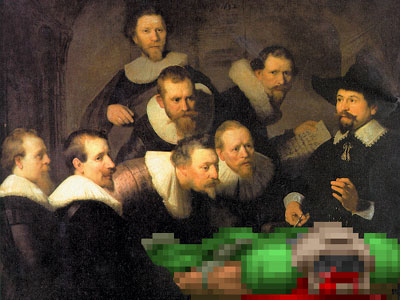
As some of you may have guessed, I’m a huge id Software fan, as a result of spending countless hours playing (and sometimes modding) their games over the last twenty years, and appreciating the vast amount of technical innovation they’ve achieved to the benefit of the industry as a whole. They’ve not always been the only guys innovating in particular areas, but, like Sega in the arcades, they’ve done a lot of the heavy lifting.
As id’s releases have slowed in recent years, ceding the limelight to the likes of Valve, Epic and Blizzard, there has been a worrying trend to downplay their historical significance. The cynic in me (i.e., me) thinks that even if their forthcoming game Rage turns out to be an amazing return to form it still won’t reverse the trend, as the narrative has already been set: id/Carmack have the gall to treat games as cold, emotionless engineering challenges, so it’s not possible that the end result can succeed as entertainment as well. (“You may think you’re having fun, but, SIGH, you’re just shooting things…”)
With the launch of Rage fast approaching, we can expect gaming’s many dimwits to dutifully drag out the usual hoary old cliches about id and their games. If you feel the urge to join in, remember you don’t have to have seen or played any of the games in question – in fact, if you were too young or simply exclusively focused on console games when Doom and Quake came out, you have all the more reason to be irrationally dismissive about one of the most important and influential development studios ever.
Here we go:
(more…)
Tags: brown, commentary, doom, Id Software, john carmack, monster closets, pedantry, quake, rage, rant, stupidity, tech demo, wolfenstein
Yesterday I attended the fourth GameCamp event, held at London South Bank University’s Keyworth Centre.
As with the previous GameCamps I attended (2008, 2010), the event was organised following the ‘unconference’ model. Attendees were free to book any one of fifteen rooms throughout the day in 30 minute slots, to talk about (or play) anything they wanted.
As there were around 300 attendees – twice that of any previous GameCamp – some logistical issues arose with the venue. Most of the rooms could only accommodate 20-30 people tops, and signposting, movement between rooms, access to refreshments, ventilation, etc. were sources of frustration.
In spite of these problems, the event was able to deliver the expected mix of highly informative and varied sessions, although the continued attrition of ‘big name’ attendees since the first GameCamp resulted in there being fewer true stand-outs.
I won’t write up blow-by-blow accounts of each talk I attended here – as my notes weren’t very thorough, and this wouldn’t take into account conversations I had (and games I played) between sessions and after. You can see the whiteboards of the even schedules here: Morning, Afternoon (courtesy of Dr. Mike Reddy).
I attended the Game Literacy/Facebook, Sex!, Structure vs. Freeplay, Narrative Debate, Flash Game Design & Business, Dialogue Trees, Fail States, Awesome Flash Games (my session), and Post Mortem sessions, and poked my head into a few others. Board and card games again had a strong presence, and I got to play The Resistance and Once Upon a Time in the bar afterwards.
The central info-hub of photos, notes and impressions is here: http://gamecamp.org.uk/2011/05/15/this-was-a-triumph/
Below are some additional notes on my talk, as promised.
(more…)

A while ago I finally caved and bought the shiny, voiced, HD remake of Monkey Island 2: LeChuck’s Revenge on Steam. The recent round of Q&As and interviews with the Portal 2 writing team (where they reveal that the writers actually cued up the recorded voice performances in the game themselves, to ensure that the comedic/dramatic timing worked as intended) has reminded me about it, and the specific reasons in which I think LucasArts unfortunately screwed it up.
(TANGENT: If you haven’t played Monkey Island 2 before, I would strongly recommend playing the original DOS version of the game through SCUMMVM before the Special Edition. Also, I’m only referring to the PC version of the Special Edition here. The quality varies widely between platforms. The iOS port in particular is almost unplayable – omitting the developers’ commentary, bonus galleries and even the intro, trashing the classic mode’s graphics, making dialogue unskippable and failing to support task switching – glaring flaws which almost all iOS reviewers ignored. A low price doesn’t excuse shoddy work, especially when compared to the polish evident in similar remakes, such as Broken Sword. TANGENT ENDS.)
I approached this remake with some trepidation. Monkey Island 2 is my favourite of all the SCUMM games, and involves substantially more complexity and subtlety than any of its predecessors. LucasArts’s previous attempt at reviving a SCUMM game (the original Secret of Monkey Island) was a disaster. The new artwork was sloppy, seemingly only included to meet console marketing requirements, and couldn’t be switched off without also disabling the voice acting. It was rushed out and it showed.
In fairness, a lot of things work well in the sequel. The animation is smoother without looking out of place. The new backgrounds are attractive and in keeping with the tone of the original game. There are still a few areas where incongruous Sam & Max / DOTT-style chunky cartoon geometry creeps in, but on the whole the backgrounds are a vast improvement over the MS Paint travesties of the first Monkey Island remake.
(more…)
Tags: game title, lucasarts, monkey island, monkey island 2, PC Gaming, rants, scumm
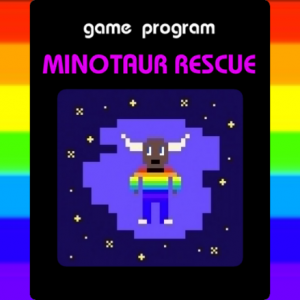
Minotaur Rescue (a.k.a. “Solar Minotaur Rescue Frenzy”) is Llamasoft‘s (i.e. Jeff Minter’s) first game for iOS. It’s available as a universal app which natively supports iPhone and iPad device configurations. The game is part of the “Minotaur Project“, a series of games modelled after the design sensibilities of different eras of computer hardware, but unbounded by the cost and technology-driven limitations of the real hardware of the time.
Minotaur Rescue purports to be a game made for the fictional “Ataurus TVC 2605”, a device which has the graphical output of an Atari VCS, the text overlay of a Commodore VIC-20, and the ability to render a seemingly unlimited number of sprites, particles and feedback effects without slowdown, thanks to Llamasoft’s NEON engine.
The gameplay is most easily described as a mash-up of Asteroids and Space War. The player pilots a small, constantly-firing triangular ship around a toroidal area of space (i.e. a single screen which wraps at the X and Y boundaries).
The ship is controlled via an ingenious ‘virtual trackball’ interface. Gently stroking anywhere on the touchscreen sets the heading and acceleration of the ship. This allows for rapid lunges across the screen as well as more subtle steering. I expect that other top-down iOS games will quickly adopt this input method.
(more…)
Tags: Asteroids, game title, iOS, iphone, Llamasoft, Minotaur Rescue, mobile games, Space War, YaK
Yesterday, the second ‘World of Love‘ indie games development conference was held at Conway Hall in Bloomsbury.
The day was packed with interesting talks from developers with disparate approaches and levels of experience. Participants brought practical advice and anecdotes, inspiring calls to action, and willy jokes. Here’s a run-down of the day’s events:
Ricky Haggett and Richard Hogg of Honeyslug talked about the process of developing their forthcoming game Hohokum. The game was probably already familiar to most of the crowd (having been previously shown at the Indie Games Arcade at the Eurogamer Expo last year), but this presentation gave a run through of the various forms the game has taken over the past three years or so (shooter, platformer, golf game, etc.), and to the process by which the duo have decided which ideas to explore and which to cut.
One fact-nugget that seemed to resonate was the idea that ‘playful’ messing around in a game is only fun if there’s a ‘proper’ task the player is wilfully ignoring by choosing to muck about. No release date for Hohokum was mentioned but it can’t be far off now, surely.
Next up was Tak Fung of Supermono, developer of MiniSquadron and Epic Win for iPhone. Tak seems to have taken a similar path to other ex-major studio employees like Cliff Harris and the Hello Games team, but pointed out that by gradually weaning himself off dependence on contract work he was able to make the transition to full-time indie while managing the level of risk. It’s impressive that a team of two guys (Fung and artist Dave Ferner) have managed to release two successful games in just over two years.
Third on stage were Ella Romanos and Martin Darby of Remode Studios, best known for their casual downloadable game Mole Control. They discussed how to go about setting up a studio / digital agency from a purely pragmatic business perspective. Useful fact: it’s apparently very easy to get R&D tax credits.
(more…)
Tags: conference, dark wind, honeyslug, indie, mode 7, pc games, preloaded, remode, rock paper shotgun, supermono, world of love
Earlier in the week we finally hit the big scary launch button on Isoball, the iOS/Android puzzle game that I’ve been producing at Zattikka for the last few months. You can get the lowdown in the launch press release, and versions for iPhone/iPad Touch, iPad and Android are now available on their respective App Stores.
We’ve also done Lite versions for iPhone and iPad. (The Lite version is 10 levels which can be completed fairly quickly – the remaining 40 levels in the full game ramp up the difficulty significantly, and include new blocks like conveyors, bridges and teleports. In playing time terms the Lite version represents considerably less than one fifth of the full game.)


The smartphone game is based on the Flash game Isoball 2 by Candyflame, and was ported by Eclipse Interactive up in Manchester. Hats off to both of these teams – Candyflame for coming up with such an ingenious design in the first place, and Eclipse for adapting it to the particular quirks of each target platform.
But that’s not all! We’ve also just released Isoball 3 on Flash, which has 75 new levels and generally beefs up the presentation and feature set of Isoball 2.
This is all pretty exciting! And I would of course be eternally grateful if, should you have any interest in puzzle games and a suitable device, you could download and rate Isoball. It’s only £0.59 ($0.99) on iPhone, that’s less than 1p per level (including the bonus levels).
Merry Yulesmas, games-chums!
Tags: android, game title, games i've done, iphone, ipod touch, isoball, isoball 3, mobile games, puzzle, smartphone, zattikka
A few weeks ago I was made aware of this Kickstarter project. (Which has since been launched.) For those who can’t be bothered to read and watch all that, in a nutshell, ‘Gameful’ is a not-for-profit initiative started by Jane McGonigal and associates intended to give funding and support to games projects – but not just any games projects, those that are deemed to be “reality-changing, life-changing, game-changing or world-changing”.
Now, I’m aware that I might come across as a contrarian arse to criticise a project that seems to be completely well-meaning and benign, but a few things about it stick in my throat.
1. Entertainment is a dirty word. The misguided utilitarian philosophy behind the (failed) serious/persuasive games movement looms large over Gameful’s mission statement. Work in any artistic medium does not have a social responsibility to be edifying. The assertion that “entertainment” is a mindless activity and cannot include ideas that go on to have any utility in a broader context unless they’ve been explicitly put there is both dead wrong and impossibly patronising.
Even the most crassly commercial games are made by skilled, emotionally complex human beings with the conscious goal of capturing the player’s interest and provoking a response. I strongly suspect that a lot of the rhetoric against ‘mainstream’ games comes from people who exclusively or predominantly play WoW – certainly McGonigal’s examples involving ‘games’ are heavily weighted toward it. Sitting down with a few games that have more narrative and simulation complexity and nuance than Tolkien’s Biggest Ever Skinner Box (I’d suggest starting with Ultima IV and working towards Machinarium, Bioshock 2, etc.) would quickly disabuse them of this belief.
(more…)
Tags: commentary, elitism, gameful, jane mcgonigal, nonsense, rant
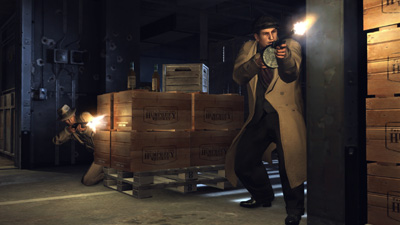
Before we can get down to discussing the long-awaited second installment in 2K Czech’s rich-simulation crime saga, we must first clear up a piece of mindless vandalism. I am referring of course to Eurogamer’s catastrophically mishandled review, penned by freelancer John “Who?” Teti.
The review shows the downside of Eurogamer’s freelance review policy. Their reviewers have the liberty of interpreting both their remit and the site’s scoring system as they see fit (making attempts to statistically analyse their scores pointless). Giving complete free rein to a reviewer can yield stunning results when the writer has extensive experience and is willing to take the task seriously. Sometimes the results can be polarising, but at least it’s possible to glean a coherent picture of why the reviewer came to their conclusions. In the hands of a dismal amateur, hell-bent on shaping their shallow critique around faulty preconceptions about the developer and publisher, it’s a loaded gun.
Teti has decided (against the evidence of playing the game or its predecessor) that 2K Czech are cynical, barely-literate jerks, and that the game’s refusal to cater to his remedial tastes must be their fault rather than his. To service this fiction he magnifies the game’s flaws and invents a host of new ones. He spends most of his time petulantly whining that the game isn’t fun if you try to play it like GTA. He describes the quality of the writing as “[having] a systemic disdain for the English language”, when Bill Harris (a writer who Teti could learn a great deal from, from tying his shoelaces upward) holds the view “The first 13 chapters were, bar none, the finest writing I’ve ever seen in a game”. Gosh, who to believe?
I could go through Teti’s bullshit hatchet job line by line, but it would just be tedious (and anyway forumite Monkichi – again, a calm, measured, non-histrionic voice with infinitely more credibility than Teti can ever hope to achieve – has already saved me the trouble). It’s puzzling that the editor who commissioned the piece (shot through as it is with factual errors and cheap, baseless attacks) didn’t question it.
Anyway, that’s far more attention than Teti’s ineptitude warrants, so on to the game.
(more…)
Tags: 2k czech, game title, mafia, mafia ii, PC, rant, storytelling
As you have probably seen by now, it’s been revealed that PC Zone magazine is set to close, going out with a (hopefully) triumphant farewell issue, to be edited by stalwart OXM editor Jon Hicks.
I’m slightly surprised that I’ve never written anything on this blog about PC Zone, a magazine which I took for over a decade from its launch in 1993, and which was my favourite games magazine for much of that time.
All the eulogies of the magazine that I’ve seen have dwelt on a handful of controversies that occurred during a ‘Maxim-esque’ phase of the magazine’s life in the late 1990s (coverdisk porn, joystick-groping nuns, banned cartoon strips and prank phonecalls, the latter two being the work of a pre-media-moguldom Charlie Brooker, whose moderately successful stint at the magazine has predictably gained a legendary status).
Conventional wisdom has it that PC Zone was more puerile and lightweight than the more respectable PC Gamer. There’s a grain of truth in this, but the laddish reputation tends to overshadow the fact that PC Zone contained a lot of very good, innovative and influential writing.
(more…)
Tags: commentary, magazine, mr cursor, PC, pc zone, retrospective

Spurred on by the success of earlier UK indie game jams (including this one), Ricky “Honeyslug” Haggett, Terry “VVVVVV” Cavanagh and co. organised a weekend jam to coincide with Pixel-Lab’s World of Love indie development conference. In spite of my continued insistence that I can’t program, I went along, and even made a couple of (fairly awful) games. Over two dozen other gaming enthusiasts also showed up, including Eskil Steenberg and Kieron Gillen.
You can read my rather whimsical report on the event at Honeyslug’s site.
You can play the game I made as well as everyone else’s at Cambridge Friendship Club.
But please, do not play Vegetable Game.
Tags: Frozen Lake Folk Duo Reunion, gamejam, games i've done, london, Vegetable Game, world of love
I’m a fan of Cracked (dot com), and I get that it’s supposed to be a humour site. I also get that complaining about a lack of journalistic rigour in one of their articles is like complaining that the presentation of a Happy Meal is too impersonal. They’re in the business of trading gentle laughs and obscure trivia for virality, and that’s fine. But this recent article by David Wong really irritated me, for several reasons.
David Wong’s schtick is to cook up superficially compelling arguments based on feel-good folk psychology that reinforce the reader’s prejudices on a subject. Synthetic profundity that sounds good until you analyse it in any detail. The most famous of these is the entertaining “What is the Monkeysphere?”.
Sporadically he applies this technique to the subject of video games. The reasoning behind this is unclear, as it’s obvious from even these infrequent excursions that Wong is only aware of games in terms of the few clumsily reported stories about them that penetrate the mainstream media.
The entire piece is underpinned by the ugly, divisive implication that “gamers” refers to a tribe of privileged American young men. It is (ironically) a perception of people who play games in the second decade of the 21st century taken straight from the ridiculous and clueless way in which they’ve been marketed in America for the past thirty years. American games magazines are full of these extraordinary relics, routinely depicting their target market as Bart Simpson-esque teenagers or bottle-glassed dorks who buy games explicitly because they contain obnoxiousness and gore.
(more…)
Tags: commentary, rant
Last Saturday saw the return after a two year hiatus of Gamecamp. I joined about a hundred games enthusiasts at the offices of eBay in Richmond for another day of talks, games, arguments, hospitality and booze (with Unity graciously footing the bar bill).
My impressions of the atmosphere of the event are broadly similar to Kieron Gillen’s. There seemed to be less excitement and optimism than the last time.
Personally, large-scale gatherings of games people (‘for their own sake’ as opposed to LAN parties or trade shows) seem much less of a novelty than they did back in 2008. At the first GameCamp nobody knew what to expect. The number of bona fide gaming luminaries wandering about was startling, many of whom were sorely absent this time. (Not to say that this year’s lineup was entirely lacking – both Ian Livingstone and Steve Jackson were there, for goodness’ sake.)
In the wake of the economic downturn, studio closures, the rise of Zynga, etc., it is perhaps only to be expected that our collective enthusiasm has been sapped over the last two years. (On the positive side, nobody was talking about ARGs.)
Gamecamp’s format works so well because the talks are informal, the audience can be assumed to be up to speed, and the subject matter can be literally anything. I attended these ones (ducking into others briefly):
- Emmeline Dobson gave a talk about why bullet hell shooters are great. And importantly for a PC-centric audience, why they’re accessible.
- James Wallis explored games as means of creative expression, where many of the crowd put forth their own anecdotes.
- Alice O’Connor tried to figure out how to make pro gaming watchable.
- Phill Cameron tackled procedural content generation (“Death of the Designer”!).
- Kieron Gillen talked about game narrative, and how it’s peculiarly different from other media.
- Some idiot-hole breathlessly tried to rattle off all the unjust conditions and remedial attitudes that are holding games back in 25 minutes.
- Margaret Robertson gave about a dozen talks, the one I caught being about the intriguing-sounding audio-only iPhone game Papa Sangre.
- Finally, there was a welcome return of the People’s Revolutionary Committee, where Farmville, crap sliding block puzzles, ludonarrative dissonance and Quick Time Events were sent to the wall.
All in all, it was a great success, and hopefully we won’t have to wait two years for another one. (There were some intriguing murmurs about revisiting the format under the Rock Paper Shotgun banner…)
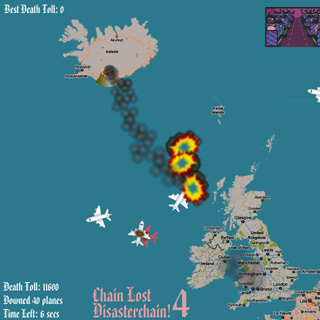
Last weekend, a collective noun of UK indie games developers were invited to the North London home of Honeyslug‘s Ricky Haggett for an intensive two-day programme of designing and implementing experimental games.
Among the attendees were the host Ricky (Kahoots, Poto & Kabenga), Terry Cavanagh (Don’t Look Back, VVVVVV), Craig Forrester (Ishisoft), Elliot Curtis (Making Fun Games), Jim Riley, Adam Schofield and on piano accompaniment, Rob Haggett (The Slips).
Among such formidable company I felt a bit like someone turning up for a jam at Eric Clapton’s place with a kazoo, but my lack of practical coding ability (and, erm, a laptop) were quickly accommodated for, allowing me to spend the time pottering around with DeluxePaint and Klik ‘n’ Play.
The format was simple. A list of themes was collected from the participants (including “maps”, “chickens”, “sewing”, “umbrellas”, “bacon”, “chimneys” and… “chunting”?), and then selections were made from this list at random. There then began a three hour session in which everyone was to attempt to make games inspired by the chosen themes.
Saturday’s session spawned two completed games: Ricky’s Eyjafjallajoekull and Terry’s Kongregate-baiting defen. I understand that the Sunday session brought some other games near to completion, which may find their way onto the internet soon.
Having not attended any kind of ‘jam’ before, I was sceptical that anything substantial or interesting could be produced within such a brief timeframe. While the released games are rather lightweight and silly, the actual ‘jam’ process was both entertaining and informative.
The bizarre themes encouraged everyone to perform experiments they probably wouldn’t have considered otherwise, and ideas and suggestions were bounced around in all directions. Seeing the working methods of seasoned developers outside of the typical development schedule and considerations was also illuminating.
The event was successful enough among the group that future jams are already in the planning stages. Will these sessions shed light on the mysteries of “Mothsps”, “Chicky Wizz” and “chunting”, or will they throw up even more inexplicable things? Either way, it’s sure to be a fun time.
Tags: chunting, defen, distractionware, eyjafjallajoekull, gamejam, honeyslug, mothsps
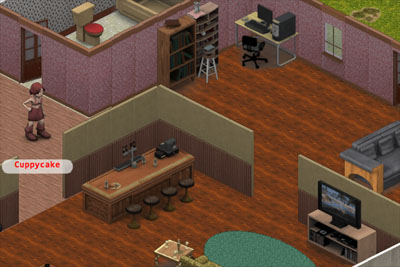
Shortly before Christmas it was announced that Metaplace was closing its doors to the public on January 1st 2010. Metaplace (which I briefly wrote about last year) was the web-based virtual world construction kit masterminded by Raph Koster (of Ultima Online, Star Wars Galaxies and Theory of Fun fame), had shown a great deal of promise but had failed to generate enough interest (nor presumably revenue) to justify its continued upkeep.
This is a great shame. Metaplace’s core concept – that appropriately designed virtual worlds could be as frictionless to create and interact with as YouTube videos – is still a compelling one, and one that hopefully will some day be solved.
While I dipped into Metaplace occasionally (attending in-world events and making a couple of small sandbox worlds in an effort to learn the tools), I can’t claim to have put in the time and effort exploring the worlds on offer to give an authoritative account of what the community achieved. While the technology was theoretically capable of representing worlds in a variety of ways (3D, 2D, birdseye, isometric, even plain text), most of the content was geared towards tile-based isometric worlds at around the level of sophistication of Ultima Online. It could perhaps be best described as an update of DikuMUD for the broadband age.
While most of the worlds that users made were fairly small and crude, the breadth of subject matter was impressive. Memorable worlds that I stumbled upon included a recreation of 1880s Whitechapel (populated with Ragnarok Online sprites) intended to teach about the Ripper murders, a virtual hospital, various explorable galleries built by graphic designers and musicians, a Star Trek ship, a transgender memorial garden and (depressingly inevitably) a “pro-traditional marriage” advocacy centre. It was possible to embed YouTube videos, audio streams and web links directly into worlds, making it easy for anyone to populate their worlds with entertaining content. Any world could be linked to any other, making exploration very organic and frequently surprising.
(more…)
Tags: commentary, flash, Metaplace, MMO, Raph Koster, second life, ultima online, virtual world
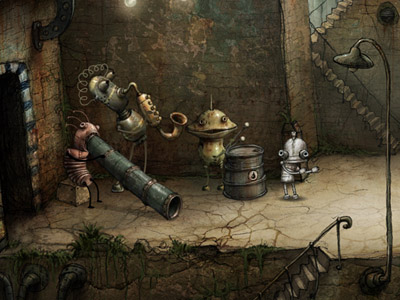
Machinarium is a point and click adventure game for the PC by Czech independent development studio Amanita Design. I still dimly recall playing Amanita’s debut game Samarost in 2003, and thinking at the time that I’d pay good money for a full-length, commercially released game with the same gameplay style. (Samarost was more of an interactive picture book than a traditional point’n’clicker, having more in common with the Gobliiins! games than those of Lucasarts or Sierra.)
It’s taken them longer than I expected, but then Machinarium is more than just a graphically polished retread of Samarost.
Machinarium tells the story of a small tin robot who seems to be on the bottom rung of a robot society that inhabits a mysterious decaying city. The game opens with the protagonist being unceremoniously dumped (in pieces) in a landfill out in the wilderness, with the immediate task being to find his scattered limbs and get back inside the city walls.
The game has no dialogue, with all relevant plot information being conveyed through the actions of characters, and the occasional ‘thought bubble’ flashback detailing the robot’s past experiences. Without giving too much away, the cause of the robot’s predicament is a plot by a gang of robot ne’er-do-wells (the Black Cap Brotherhood), who have kidnapped his girlfriend (oh god no, what a cliché, how terrible, shut up) and are building a bomb.
(more…)
Tags: adventure, amanita design, flash, game title, machinarium, PC, robots, samarost
