
Hello.
My name is Robin, and this is my website about computer games. Here you can find essays about old games, industry commentary, free games I've made for fun, and funny songs.
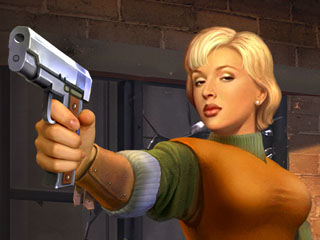
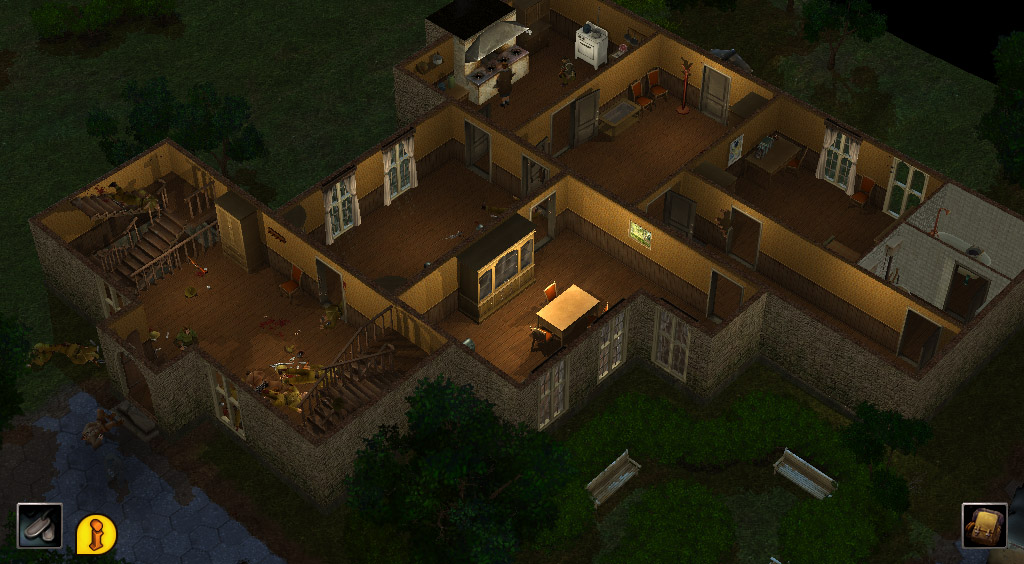
Silent Storm is a turn-based tactical combat game for the PC, in which the player controls an elite commando unit during an alternate universe World War II. (The fantasy setting becomes more obvious later in the game as the existence of various improbable experimental weapons is revealed.) The game was developed by Russia’s greatest PC games machine, Nival Interactive (Etherlords, Blitzkrieg, HOMM V) and released in 2003. The game takes the basic mechanics of turn-based squad games (as seen in Laser Squad, X-Com and Jagged Alliance) and grafts them on to a deeply physically simulated 3D environment.
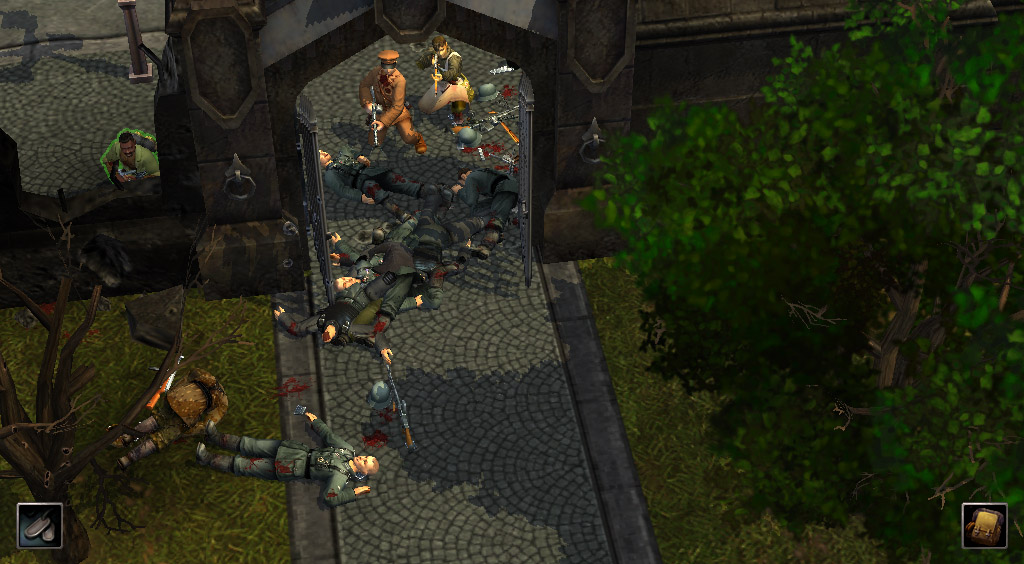
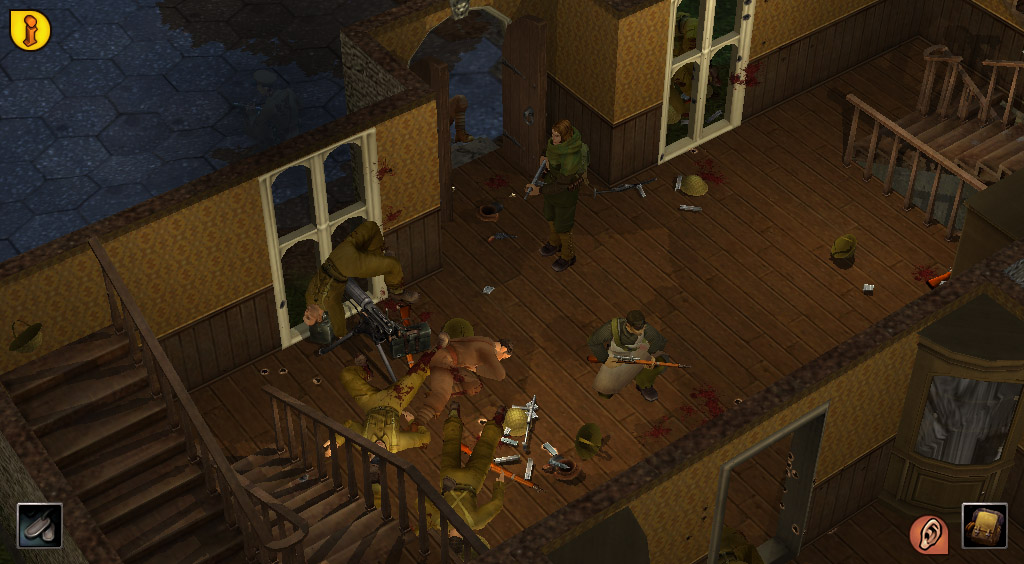
The game’s major innovation is the completely destructible nature of the environment. Everything in the game (and this isn’t just limited to scenery objects or specially designated ‘weak’ walls) has material properties and can be destroyed with a sufficient amount of force. Destruction isn’t a binary state either. The game’s buildings are made up tile-based sections, which are further subdivided into individual pieces, so bullets and explosions can carve irregularly shaped holes in walls and floors.
This makes the idea of cover a relative concept. If you can hear someone on the other side of a wooden door, you can quite happily loose a hail of sub-machine gun bullets through the door in their direction (albeit with limited in accuracy). You can concentrate fire on part of a building to give your sniper a clear view of the goons inside. (Everything works on true line of sight.) Blast a big enough hole and your soldiers will naturally be able to clamber or crawl through it, so you seldom have to confine your route to the existing staircases, ladders and entry points.
The malleable nature of the world doesn’t just add to the gameplay, it is the gameplay. It sets Silent Storm apart from previous entries in the genre. One could easily imagine 2D games like Laser Squad or Jagged Alliance being implemented with miniatures and dice, but it would be impossible (or at least staggeringly impractical) to recreate Silent Storm’s design in this way.
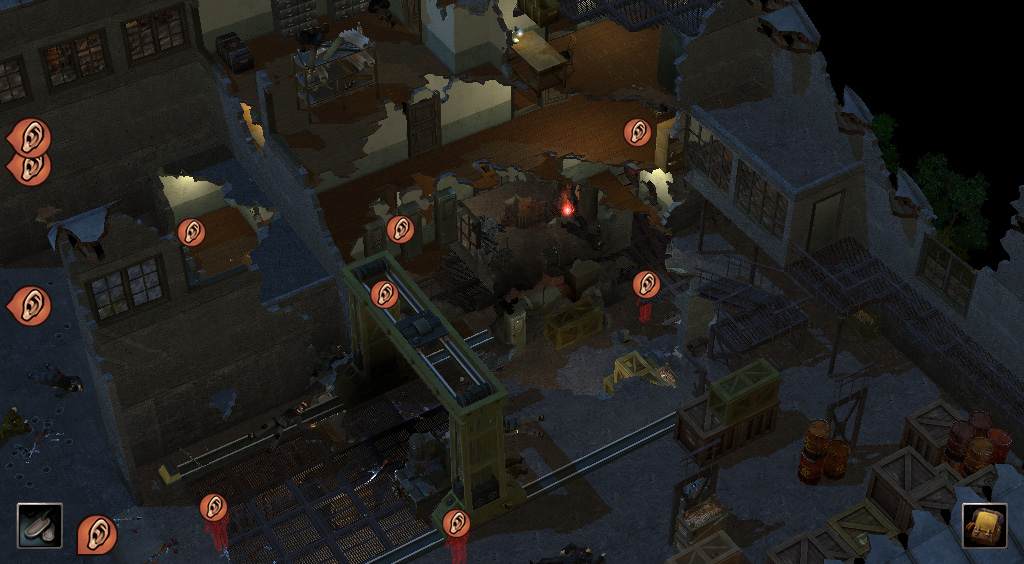
The other distinguishing aspect of the game is the inclusion of what the developers call “RPG elements”. These essentially consist of a set of stats and a skill tree for each member of your squad. Characters aren’t constrained to their starting classes, so it’s possible to build up their stats in other areas without penalty. Apart from the ‘hero’ character (for whom the player can specify a name, face, voice, gender, nationality and starting class), the rest of your squad is recruited from a pool of predefined characters. Unlike Jagged Alliance, there’s no personality system preventing certain characters from working together or causing them to bear grudges.
The glue that holds the missions together is perfunctory but adequate. The campaign system adds new plot-advancing missions to the game map which can be tackled in any order. Completely optional random encounters also appear on the map, which can be useful for increasing your characters’ stats and gaining a little extra ammo and equipment, but are typically so short and simplistic that there’s not much point in opting to play them once you have a few of the main missions under your belt.
There are dozens of weapons and items available to equip your squad, which can be obtained in the field or from the generously stocked armoury at headquarters. There are at least 10-20 of each of the main weapon types (mêlée, pistols, rifles, submachine guns, heavy weapons, grenades) as well as loads of medical (bandages, forceps, morphine) and engineering (lockpicks, explosive charges, landmines) items. As well as the usual variables for each weapon (clip size, weight, power, firing speed, etc.) there’s also a stat for how easy the weapon is to learn. Individual characters gain greater familiarity with the weapons they use most often. Equipping a squad prior to entering a mission is quite engrossing and offers lots of scope to indulge obsessive-compulsive tendencies.
The range of skills and weapons available, combined with the level of detail in the simulation, affords the player an enormous amount of freedom in how they approach each mission, similar in design ethos to the Hitman games.
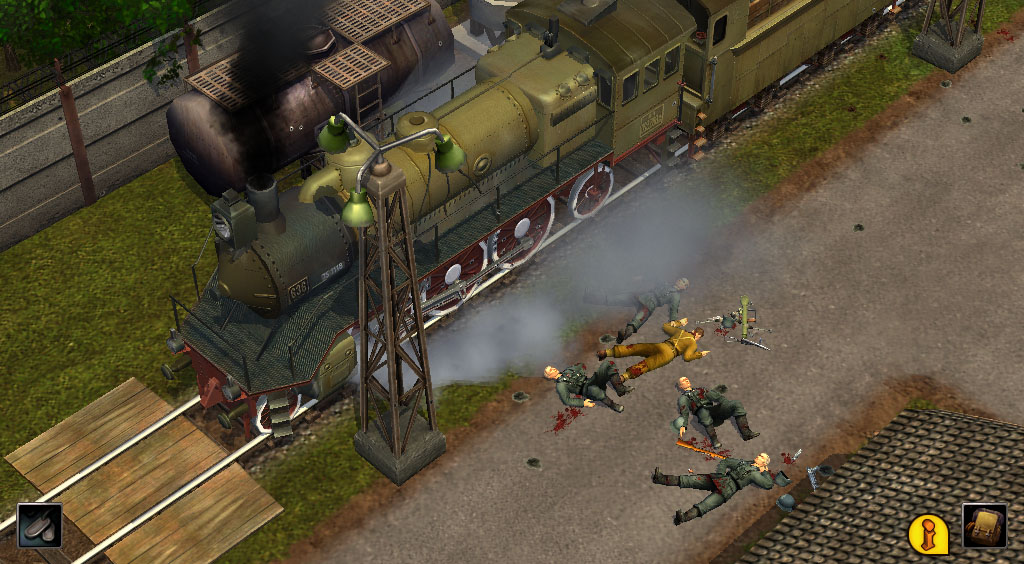
The game’s visuals still stand up well today. It’s true that even on modern hardware the engine feels a bit more sluggish than it should (especially compared to HOMM V, although it’s possible that the latter game is being asked to do fewer calculations) and the per-pixel lighting is frequently glitchy. The maximum resolution of 1152×864 pixels also takes the edge off a bit. Even with these shortcomings, the detail of the characters and environments is still pleasing. (For some historical context, the first time I saw an alpha of the game running in late 2002, I thought that the character models were prerendered – in the style of Commandos – until the camera was rotated.)
The particle effects and rich, hand-painted looking texture work (Nival’s visual trademarks) are typically excellent, as are the ragdoll deaths (quite a new development at the time). The scenes left in the aftermath of particularly eventful missions, of battle-scarred, semi-collapsed buildings strewn with corpses, are eerily reminiscent of the Chapman brothers’ Hell dioramas.
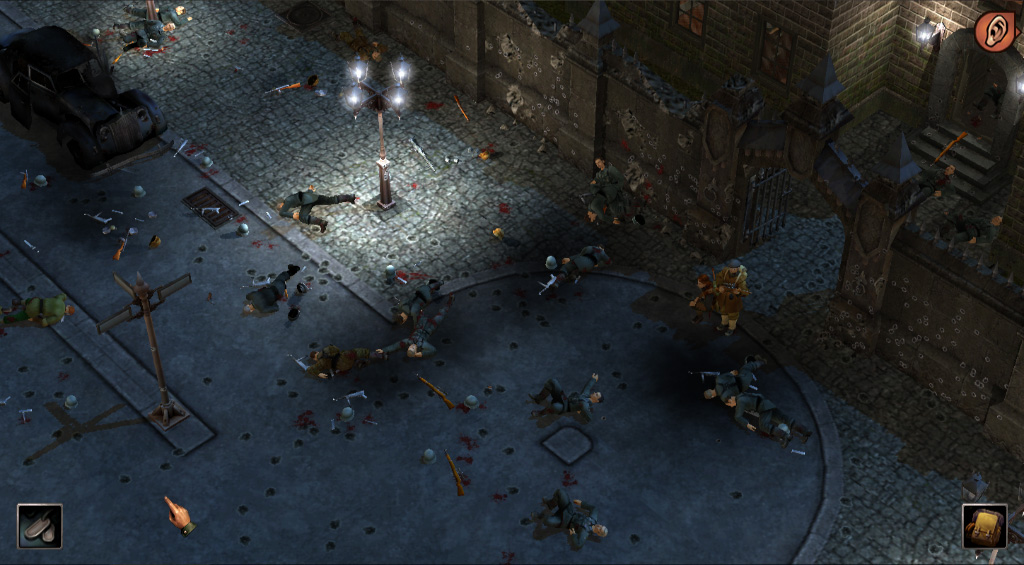
In spite of the brilliance with which the core gameplay is implemented, Silent Storm does have it’s fair share of shortcomings. The most glaring is that there are no multiplayer modes, a staple of the genre since the early days, and something which would seem easy to implement (at the very least offering hotseat or play by email).
Enemy turns can take an excessive amount of time (partly because their animations are played out at the normal speed when you can see them). On levels where there are several friendly AI characters and enemies engaged in battle, you can spend more time watching them duke it out than actually making your own moves.
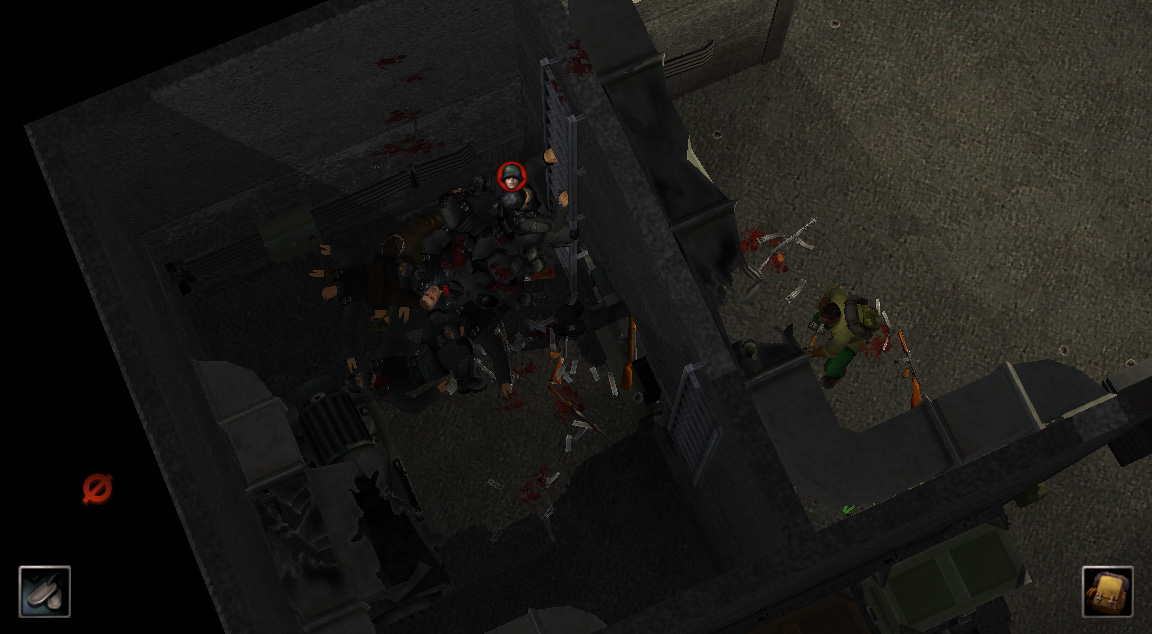
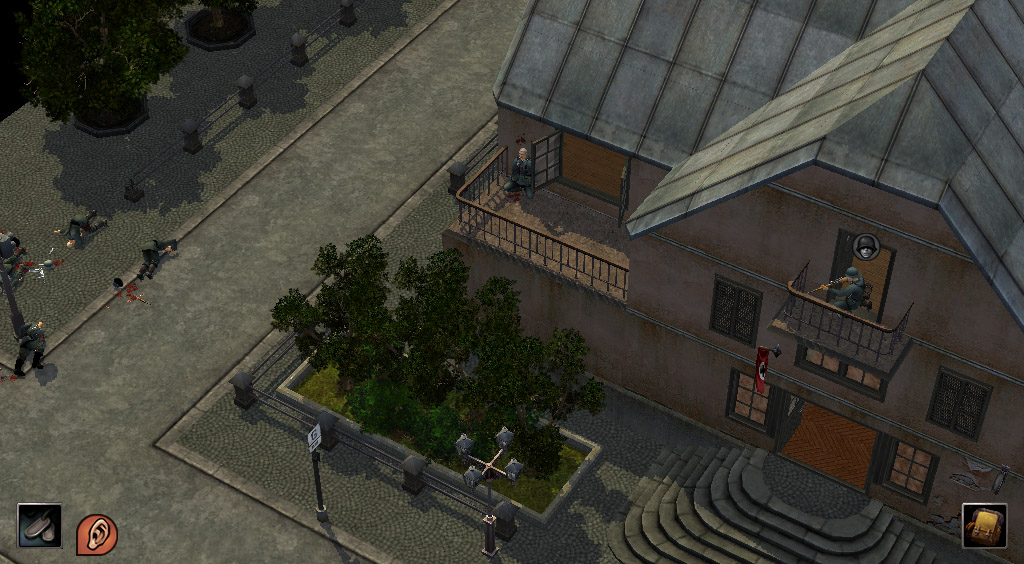
The enemy AI also has some issues. Pathfinding (for enemies and the player’s squad) is handled excellently, but enemy characters lack much sense of self preservation or awareness, seeming happy to charge through doorways that are already littered with corpses of their comrades (as seen in the image above). They also seldom use stealth (although they tend to be absolute bastards on the rare occasions where they successfully ambush you) and don’t seem to be able to use grenades. Because of these problems (as well as the issues described at the end of this article), and the fact that it all does ultimately get a bit predictable, I would expect that most players would play the game until they reached a point where they’ve had enough, rather than fall victim to 100+ hour addictions.
Silent Storm is a game that unfortunately passed most people by on its original release. The game failed to find a wide audience thanks to a combination of bad timing, poor marketing and what at the time seemed like excessive technical requirements (especially for a strategy game). JoWooD (who were originally slated to publish the title) were in financial difficulties around that time, and sold off the publishing and distribution rights to various external parties.
The fact that the game was turn-based was considered a problem when it came to marketing. With the unstoppable rise of the RTS over the past decade, it has become extremely difficult to even get a turn-based game released, let alone to generate commercial and critical interest. In recent times only Nintendo (and to some extent Atlus) seem to have been able to buck the trend, with games like Advance Wars and Fire Emblem.
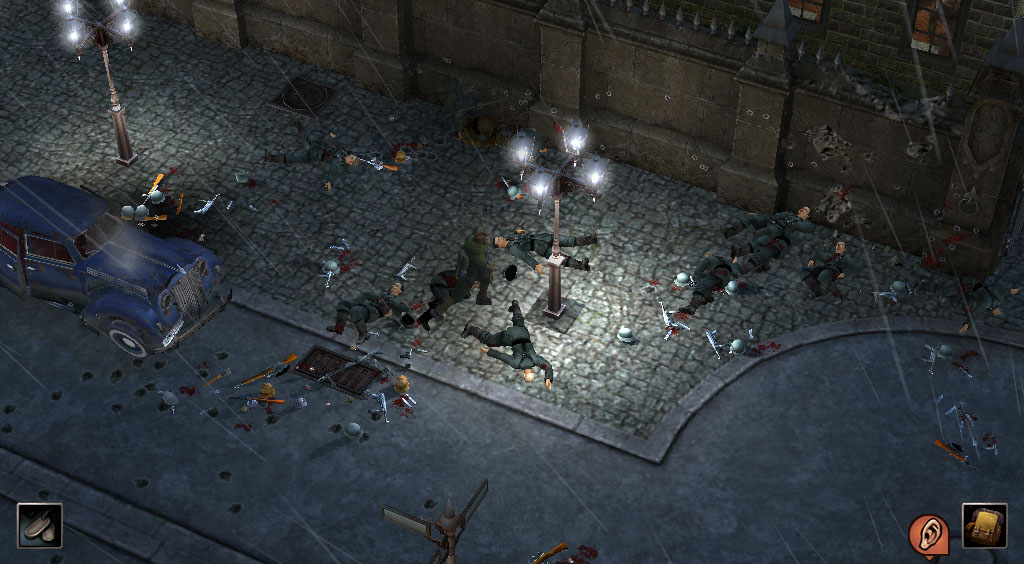
It’s disappointing that Nival haven’t built on the advances made by Silent Storm with a true sequel. (They did release at least one other game with the same engine, Hammer & Sickle, which seems to be an officially sanctioned mod.) It’s also a shame that there haven’t been any subsequent games in any genre that implement destructible environments as extensively. Destructible scenery in games is usually severely limited due to a combination of expense and time constraints, design issues (it becomes vastly easier for the player to break the game in ways the designers hadn’t anticipated), and historical technical reasons (most graphics hardware and APIs are primarily designed to optimise the rendering of static environments).
It occurs to me that turn-based tactical strategy games would be ideally suited for episodic delivery. Games like Front Mission and Faselei!, with a strong narrative focus, give a good idea of how a mission or mini-campaign could be packaged up as a stand-alone experience. It might not even be strictly necessary for the player to play through every episode in order, and they could carry over their characters and equipment from one episode to the next. (Obviously some balancing issues would be need to be addressed.) Replayability would be increased if there were secondary (or hidden) objectives and multiple ways to complete the mission.
Such a game would probably need well-written (and quite varied) characters to keep players interested. I’m not aware of any developer currently exploring this route (the most actively developed game in the genre today appears to be Laser Squad Nemesis, which focuses on multiplayer), but would be very interested to see how it could work.
Tags: Game, game title, nival, PC, silent storm, turn-based strategy
I don’t like the idea of ‘retro gaming’. That is to say, I don’t like using the term ‘retro’ to describe games released several years ago. It seems to imply that old games (encapsulated as a single monolithic entity) should be treated differently to newer games. This distinction comes from a misunderstanding of why people play old games. I play lots of old games and I’m not for a single second trying to ‘relive’ anything. I have no interest in nostalgia, I’m just aware that some old games haven’t aged badly in any important respect, and in a few cases haven’t been subsequently bettered either. Furthermore my ability to appreciate them (logically enough) hasn’t remained static.
The negative aspects of isolating old games cut both ways. It casts old games in an unnecessarily poor light by encouraging people (especially the OH SO WACKY NES T-shirt brigade) to focus on the technical limitations instead of the ingenuity with which developers tried to overcome them. It also suggests that good and bad decisions made in the design of crumbly old games have no relevance to our clearly much more sophisticated modern ones.
The upshot of this is that newer games often only compared to their contemporaries, mediocre games are reluctantly endorsed by reviewers, and developers make mistakes that were avoidable years before. (Trivial example: you’d think that by now everyone would know that mapping ‘up’ on the joystick to ‘jump’ was a big no-no, yet it still happens.) A good example of how constructing an artificial divide between old and new games can be counterproductive is this recent Eurogamer article.
Tags: commentary, eurogamer, retro, toejam & earl
Game On!: From Pong to Oblivion – The 50 Greatest Video Games of All Time
Simon Byron, Ste Curran and David McCarthy
Headline, £14.99
ISBN: 978-0755315703
This rather awkwardly titled volume is a slickly presented celebration of the best experiences gaming has to offer, as chosen by three veteran games writers (who these days can be found getting up to harmless mischief on their blog).
It isn’t, obviously, an uncompromising attempt to determine the 50 best games ever made. The authors don’t disguise the fact that the aim of the book is to present a catalogue of worthwhile gaming experiences that would be accessible to the mainstream reader. Each game is given 2-8 full colour pages, explaining the premise of the game (as well as other games in the series/franchise where appropriate) and what’s so good about it, as well as providing brief directions on how each game can be (legally) obtained and played. Each entry is lavishly illustrated with screenshots, artwork and concept art.
Tags: books, character design for mobile devices, game on, video games guide
In the interest of full disclosure, I should point out that I was connected to the development of this game, and although I do not stand to gain commercially from its success, my views are inevitably going to be subjective. Don’t consider this a review, just a gentle prod that this game exists.
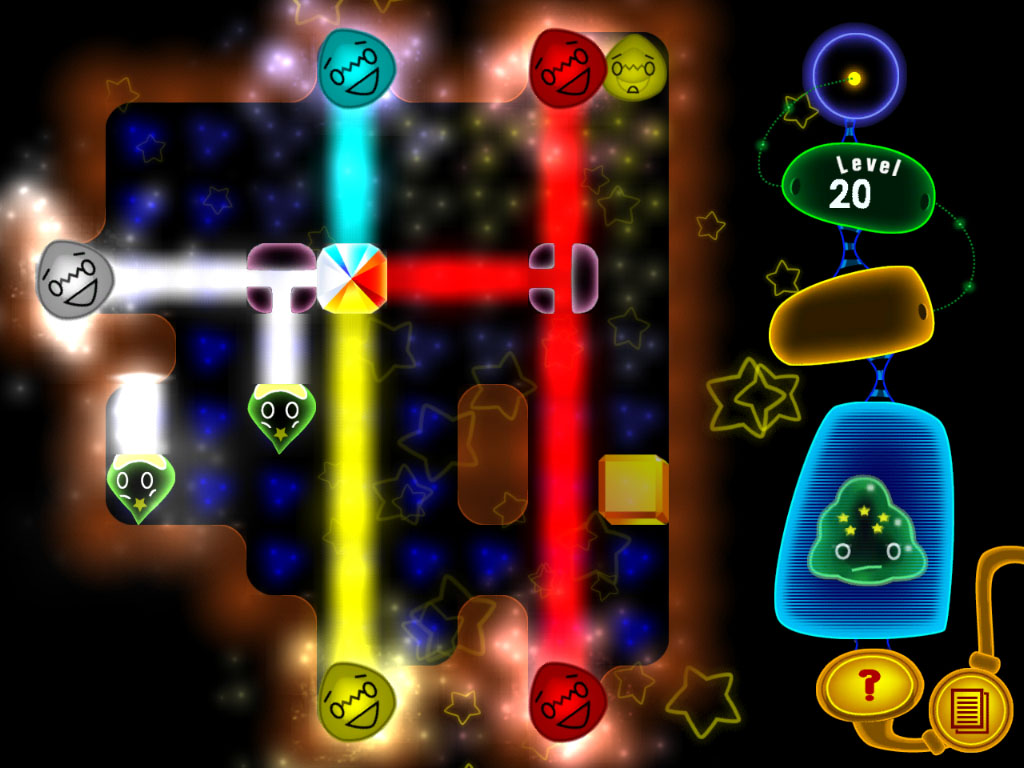
PRISM: Light The Way (not to be confused with P.R.I.S.M. – Threat Level Red) is a 2D puzzle game for Windows PCs and Java-capable mobile phones published by Eidos and available to buy right now: [PC version] [Mobile version] – although oddly Eidos haven’t (to my knowledge) advertised the game’s existence in any way.
The story of the game (in so much as anyone cares about the story in a puzzle game) revolves around cute, stylised alien creatures that live inside a collapsed star and feed on the light rays that are slurped up by its event horizon. One day a space monster jams itself in their black hole (oo-er), blocking out the light and necessitating a race of do-gooding, light-spewing aliens come to the rescue. Of course, as none of these deep space creatures have limbs, the player (in the form of a disembodied cursor) must help them move around.
Tags: casual, eidos, Game, game title, mobile games, morpheme, multiplatform, prism, puzzle
A few weeks ago I visited the Game On Exhibition at the Science Museum in London. For those who want an in-depth description of what the show offers and the overall impression that the typical game-savvy visitor is left with, I can recommend the official site and this review by Duncan Lawson, which largely tallies with my own experience.
The exhibition’s greatest achievement is that the organisers have striven to make as many of the exhibits on display playable. They’ve convincingly solved the technical challenges of keeping over a hundred disparate consoles and computers up and running at the hands of the general public. During our visit there were maybe only two or three machines out of service.
Unfortunately this commendable effort is let down by the selection of games that the organisers have chosen. It’s no exaggeration to say that it this selection seems completely random. For each notable game there are at least half a dozen non-entities that could easily have been selected by blindly buying old cartridges at a car boot sale.
Stranger still, the skew of formats and genres borders on the perverse. No coinops post 1990. No RPGs. No mention of MMORPGs. Three PC games (all of which are ports and none of which are Starcraft, Doom, Quake, Ultima VII/UW/UW2, Deus Ex or Tie Fighter), two(!) Mega Drive games (again, completely bafflingly, both ports – forgettable versions of Sokoban and Prince of Persia), and one(!?) Amiga game (Lemmings). And most damningly of all (maybe), zero Master System games (they could have at least had Wonderboy III).
In fact most (or at least an extremely disproportionate amount) of the 100+ display machines were Nintendo consoles. Yes, OK, Mario Kart, very good, Goldeneye, no problem … but (SNES) Sim City and (NES) Elite? I thought that this anomaly might have something to do with the exhibition’s sponsor, but have heard that the lineup was largely the same in previous incarnations, so it must be the curators who are at fault.
Very little effort has been spent on trying to explain how everything fits together chronologically, or what makes any particular game notable (in terms of popularity, notoriety, innovation, influence, relevance to gaming in the UK, or any other criteria). There is also a heavy degree of censorship, which swiss-cheeses any attempt to present an accurate history of games post the golden age.
Even though we found most of the show to be a disappointment, we did glean some entertainment from Saturn Bomberman and Bubble Bobble, followed by a lengthy game of Buzz! against some MOTPs. And I got a nerdy kick out of ‘speedrunning’ HHGTTG (my experiences with the Infocom games are a story for another update) and seeing some original Steve Purcell artwork for The Secret of Monkey Island.
Hopefully the exhibition will get an overhaul before its next outing, as the seeds of an informative, entertaining experience are there. Until then, you’re not missing much.
Tags: disappointment, game on
Over the past three months, the trifling minutiae of real life have hampered my ability to add content to this site. A couple of times it looked like I’d weathered the storm, only for Events to haul themselves back out of the precipice like some badly misjudged multi-stage boss monster.
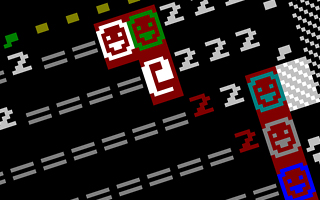
During this period, most of my playing time has been taken up by two games: Animal Crossing: Wild World for the Nintendo DS, and Dwarf Fortress, an ‘indie’ (in the sense of the word that is synonymous to the art world’s term ‘outsider’) fantasy society management sim for the PC. Two games which are about daily life in an isolated settlement, but which use very different tactics to charm you into emotionally investing in the simulation. (Also, only one of which features dismemberment.)
I’ve already posted a braindump about Dwarf Fortress here, but there are many other players who have explored the game more thoroughly and written about the game more passionately and knowledgeably than I could hope to. Bill Harris’s blog has over the last few weeks featured a slew of guides and stories (Dwarf Fortress is a game which generates better stories through the interplay of its meticulously detailed world than can be found in most games that involved teams of professional writers) which, along with the invaluable Wiki, should give you the information and (I’d hope) incentive to give it a go. In it’s current form, I find that the interface becomes too unwieldy once the population of the fortress approaches the half century mark. Perhaps once it’s easier to allocate jobs and query units without having to constantly pause and switch modes, I’ll be able to stick with it longer.
Animal Crossing I have found to be more engrossing than I had expected (I’d not previously played the GameCube version, although I had played a bit of the exceptionally tedious Harvest Moon: A Wonderful Life). The scope for personalisation and creativity is surprisingly broad, and the presence of a goal structure (which can be completely ignored should you so wish) tends to keep me checking in every day or so and discovering new stuff in the process. Having said that, I have realised that of late I’ve been doing little more than grinding away, intensively farming delicious pears, and so probably shouldn’t berate World of Warcraft addicts so much.
I’ve also been playing the new Sam & Max episode, which has led me to start playing the original game (one of the few LucasArts adventures that I didn’t play through the first time round). ‘Episode 1’ is pretty short and slight (think Half Life 2 Episode 1) but the lazy old review clichés apply: if you like adventure games, and you like the demo, you should probably get it.
I was also hoping to be stuck into Company of Heroes by now, except that Microsoft and THQ’s marketing guys decided to lock out Windows 2000 users. The total lack of negative press regarding this decision (Win2k probably accounts for a couple of percent of the PC games market these days, and Vista is out Real Soon Now) suggests that they made a safe bet, but still, it’s never cool to artificially limit games just to pressure users into needless upgrades.
Which moaning about Microsoft neatly segues to the fact that this site now renders correctly (or near enough to be useful) in Internet Explorer 6, reaffirming our commitment to some day reaching the basic standards of service expected from every other site on the web. I’d test it in IE7, but, well, it doesn’t support Windows 2000.
At some point we’ve all read (on a magazine letters page, forum or news site) a version of the following argument:
“The move from 2D to 3D graphics was a big step. The only advance that’s possible from 3D graphics is prettier 3D graphics. Ergo, graphics technology has plateaued and I was right to buy those 600 shellacked alligators stuffed with sawdust* instead of a ‘next generation’ console/graphics card.”
In fact, let’s take a specific example:
“It’s finally happened, something that some people have been predicting for a time: we’ve reached the plateau of how impressive graphics can be. In this generation, there’s not much more to be done. Realism has been achieved, for better or worse (…) And none of it, especially the characters who are supposed to be human, look (sic) …human.”
– Jane Pinckard, 1UP.com
But then making fun of Pinckard’s inane wittering is like shooting fish in a barrel of dead fish. (“Gamers, for the most part, don’t care to read about how a game makes you feel.”) More importantly, the ‘plateau’ argument has also been made by more perceptive critics and even a few developers (although not usually those whose products rely on cutting edge graphics as a major selling point).
Whenever a new console generation appears on the horizon you can count on some commentators to point blank refuse to acknowledge that, in time, developers are going to figure out novel (and geniunely progressive) uses for all that additional processing power. Even the cynical practice of making “the same, but prettier” games as the last generation almost inevitably leads developers to discover and experiment with new possibilities. Advances in visual representation will continue to play a large part in this.
The belief that graphics technology (at least, of the kind that could have a beneficial effect on computer games) has plateaued is a result of subscribing to one or more of the following red herrings:
- It is impossible to conceive of better graphics than we can currently generate in realtime.
- There has not been any significant advancement in graphics in the last several years.
- Some new factor has now come into play that negates Moore’s Law.
Tags: commentary, graphics, myth, plateau
I have a vague theory about what Microsoft are planning to do in the gaming ‘space’ in the next few years. I’ve not seen a similar conjecture put forward anywhere, so I’m not ruling out the possibility that this is either so obvious that it’s not worth mentioning, or I’m missing something important in my reasoning.
One of Microsoft’s big initiatives at the moment is aimed at revitalising PC gaming, with the focus on DirectX 10, Windows Vista and a new TWIMTBP/Seal of Quality-style cobranding programme for publishers releasing high profile games for Windows.
This sudden about-face could be viewed as nothing more than a cynical ploy to give people a reason to upgrade to Vista, but regardless of the scheme’s origins, there seems to be genuine enthusiasm from all sides for more interesting things to be done on the PC platform, which has been overlooked by large parts of the Western development community for the last few years in favour of the more lucrative (and not desperately underpowered) Xbox, PS2 and GameCube. In a way, Microsoft could be seen as going back to finish the job that was started with DirectX, with the lessons learned and technology developed for the Xboxen crossing back over to the PC. (I imagine Apple’s switch to Intel CPUs has not been ignored either.) After all, there’s no reason PC games shouldn’t be easy enough for mainstream users to install and play.
Another project Microsoft unveiled at E3 was “Live Anywhere”, which aims to add interoperability between Xbox 360s, PCs and mobile devices (including, commendably, non-Windows Mobile-powered phones) for online gaming and social networking. The upshot of this is that Xbox Live functionality is creeping into Windows Vista.
Thirdly, Microsoft (along with just about everyone else) have been singing the praises of electronic distribution, having pioneered in this market with Xbox Live Arcade. (Don’t say I never give them credit for anything.)
(Fourthly, there has to be a reason Xbox 360 pads work on the PC. That’s completely out of character.)
All these developments seem to be pointing to a situation within the next five years where Microsoft dissolve the distinction between PC and Xbox 360 games and services, or more specifically, absorb the console business back into the Windows business.
Building a single gaming platform that would allow them to get out of the hardware market must look like a very attractive prospect right now. Microsoft have burnt up something like four billion dollars developing and subsidising Xbox and Xbox 360 hardware. Indeed, ownership of their own closed, proprietary hardware platform has only been pursued as a necessary evil to allow Microsoft access to the traditional console industry (razors and blades) business model. If they could wash their hands of the expensive and difficult business of building consoles, their entertainment division would stand to benefit, but only if they were able to offer a functionally equivalent platform in software.
Electronic distribution (and the raft of subsidiary business models that it makes possible) would go a long way to fulfilling that requirement. The thorny question of whether PCs could be made cheap and/or powerful enough to directly fill the role of dedicated games consoles is still unresolved, but if the original Xbox was anything to go by, the average gaming PC will have comfortably matched the polygon-pusing abilities of the Xbox 360 within a year or so. The reaction to the conservative spec of the Wii has put a big dent in the traditional belief that console gamers demand bleeding edge graphics, anyway.
Such a move would not be a defeat in the mould of Sega’s departure from the hardware market – Microsoft’s motives would be entirely different to Sega’s. They’d still have a platform under their control (though whether they’d be so bold/foolish to use Vista as an excuse to start charging PC game developers licensing fees remains to be seen), and would still have lots of closely-guarded ways to make money from games.
If any of the above bears a remote resemblance to the contents of a flipchart in some subterranean Redmond bunker: firstly, it was a lucky guess, please don’t sic Peter Moore on me; secondly, they’re probably not spelling it out this frankly just yet because they’re still committed to hawking the Xbox 360 for the foreseeable future.
Tags: commentary, games for windows, microsoft
I’ve never bought a Sony console, and I’m not about to start any time soon*. Please bear this in mind before reading the following. I have no desire to defend Sony, but there are a couple of points that have been cropping up in everyone’s analysis of their E3 showing this year that I feel compelled to question. You’ve all been so busy fetching up your pitchforks and flaming torches that no-one has stopped to think clearly about some of these issues.
Sony’s announcement of the PS3 pricing at E3 has opened the floodgates for a lot of bitter anti-Sony sentiment and predictions of their impending doom. To anybody who has been following the headlines on GameTab (a.k.a. “the simpleton zeitgeist”) in the months since the Xbox 360’s release this won’t come as a surprise – most of the games media has been playing this tune for some time now, feverishly jumping on any rumour that reflected badly on the Playstation 3, thereby somehow legitimising their more impatient readers’ decision to drop frighteningly large sums of money on Microsoft’s nextgen machine. (In most cases, spending more than the RRP of the console itself on games, peripherals and online services.)
Let’s get the stuff we all agree on out of the way first. Yes, Sony had a disasterous E3, and will undoubtedly face problems launching a new console at $5/600. (We can stop all this whining about the $500 version being ‘crippled’ as well. It plays the exact same games. It’s OK, Americans, you can buy the cheaper version of something without worrying about people questioning your manliness. And at least you’re getting a choice.) They’ll probably come out of this hardware generation with a smaller slice of the overall pie.
But then you go and spoil it all by saying something stupid like:
“Nobody needs Blu-Ray! It’s only useful for films anyway, right?”
Tags: commentary, playstation 3
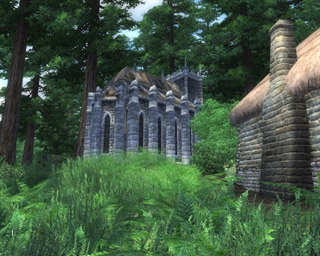
So, Oblivion then.
I’ve put in about 100 hours so far, which goes some way to explaining why this site hasn’t been updated for a while.
The game is currently being experienced by about two million people, which is pretty good going considering it’s not exceptionally mainstream in terms of genre or hardware requirements (God knows how many copies it would have sold by now if by some miracle they’d been able to cram it onto the PS2). It’s the work of a big team of people who are very, very good at what they do, and have been honing their skills to a specific end for about a decade. On top of which they have a virtually limitless budget at their disposal (which could lead off into another discussion about how sometimes Hollywood-sized development budgets can be justified – I would say Oblivion makes a better case for this than GTA:SA or this season’s flabby EA blockbuster).
Reviewers everywhere have been falling over themselves to heap praise on it, even in cases where they’ve neglected to mention anything about the sodding game. (It’s such a shame they won’t just let PC Zone die.) In the face of all this evidence it would be difficult to convince people that Oblivion is rubbish, so it’s quite lucky that it’s actually rather brilliant.
Trying to encapsulate the experience feels rather how I expect a snake feels swallowing an egg. It takes some considerable time and effort to discover, become familiar with, and eventually tire of all of the game’s systems. However unless you are entirely not cut out for computer games, you will enjoy the process of getting to that point.
Tags: elder scrolls, Game, game title, multiplatform, oblivion, PC
A few posts back I had a mini-rant about people jumping to conclusions with regards to the Playstation 3 demonstration videos Sony showed last year at E3, in particular the seemingly too-good-to-be-true sequences shown for Killzone and Motorstorm. I wanted to point out how ridiculous it was that in the absence of conclusive evidence one way or the other, some people felt the need to fabricate explanations of the demonstrations’ origins in order to ‘prove’ Sony were being deceptive.
In the intervening period, new evidence seems to have come to light: representatives of Realtime UK, an animation studio who have done lots of games-related work in the past (including FMVs for Sony’s Buzz! series, and a concept video for Real Time Worlds’ forthcoming APB), are reported to have claimed responsibility for the creation of the demos.
Obviously neither Sony or Realtime are likely to officially comment on this, but taking into account the usually-reliable people I’ve heard this from, the fact that Edge were confident enough in their sources to make the connection in print, and the stylistic similarities between the E3 vids and the materials on show at Realtime’s website, it does look like the theory with the most weight behind it.
In other news, I’ve skirted life-consuming addictions to Mu-Cade, Grid Wars 2 and Chibi-Robo, only to fall directly into Oblivion. Stay tuned for further updates once I’ve earned ‘respeck’ on the mean ‘streetz’ of Cyrodiil, or whatever the sub-Tolkien beardy equivalent is.
Tags: commentary, killzone, killzonegate
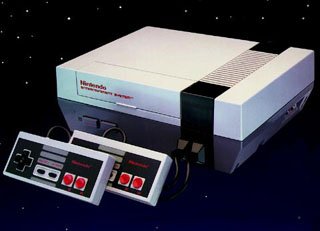
What do you see when you look at the picture above?
If you’re American, you no doubt recognise this as the Nintendo Entertainment System (NES), a console that you probably owned during its commercial lifespan. (There’s even a moderate chance that you have re-purchased one in the intervening period.) It’s also likely that you view the NES as the machine that single-handedly revived the fortunes of the video games market in the wake of the 1983 crash, and revere at least six of its games (at a bare minimum) as being timeless landmarks. It’s probably your favourite games platform of all time and you can’t envision a game industry that was not fundamentally shaped by its influence.
(If you’re Japanese you probably feel something broadly similar, except presumably with the cult status taken less seriously – perhaps resulting in a similar view of the machine as the one Englishmen of a certain age hold towards Chopper bikes.)
If, on the other hand, you hail from the UK or continental Europe, you no doubt recognise this as the NES, a machine that you almost certainly didn’t own during its commercial lifetime (a situation not helped by the fact that it wasn’t officially launched in the UK until 1987), and remember as one of the diverse assortment of 8-bit and 16-bit consoles and home computers that jockeyed for position in the late 1980s and early 1990s. You will be aware of the state of reverence that the key games in which the system’s library are held, although your first exposure to most of these franchises will have been through the Game Boy and SNES sequels, emulation, or subsequent re-releases on the Game Boy Advance. In the face of this cultural alienation, however, you may very well still be willing to accept the general consensus that the NES was for some reason in a class apart from its contemporaries.
This – all of this – is not a particularly healthy state of affairs.
Tags: commentary, NES, nintendo, nostalgia, revisionism
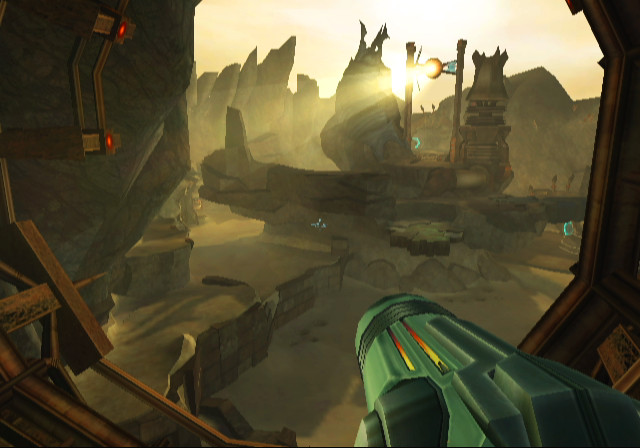
I’ve already mentioned how hugely impressed I was (and still am) with the two Metroid Prime games. The first game was an amazingly finely crafted statement of intent by Retro Studios, which had the benefit of a long development period during which to hone the level design and smooth out any wrinkles in the difficulty curve. It set a new watermark for the level of attention to detail that could be indulged in a ‘next-gen’ game.
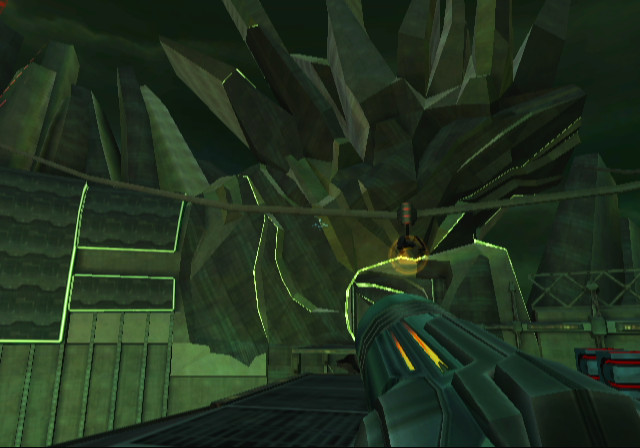
The second game ups the ante in many departments – the game world is larger and more organic, the visuals (especially the creature design) are greatly improved, and the platforming features (the Morph Ball systems, grappling hook, space jump, shinespark, etc.) are integrated much more seamlessly into the game environment.
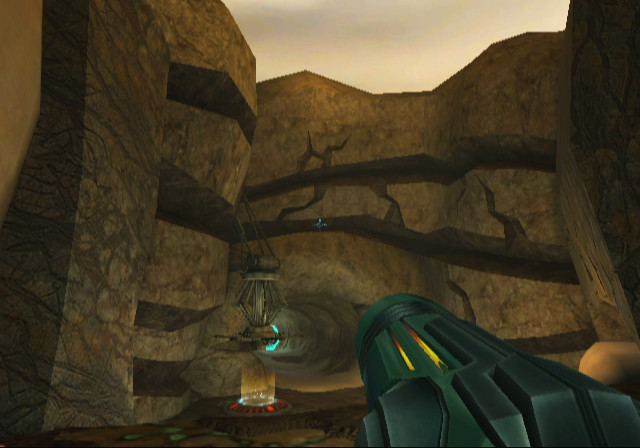
However, Retro seemed to have designed the second game with players who completed the original title in mind, which is a nice way of saying that they seriously unbalanced the difficulty curve. There are a handful of boss battles in the game that act as chokepoints, preventing any progress from being made until they are completed. These bosses are brutally difficult to beat, a situation that is not aided by the fact that they’re early enough in the game that there aren’t enough upgrades available to cushion players who prefer platforming and exploration to performing marathon feats of manual dexterity. Sections of the game such as the Spider Guardian caused me to stop playing entirely for an extended period of time, frustrated by the fact that I was failing at my entertainment.
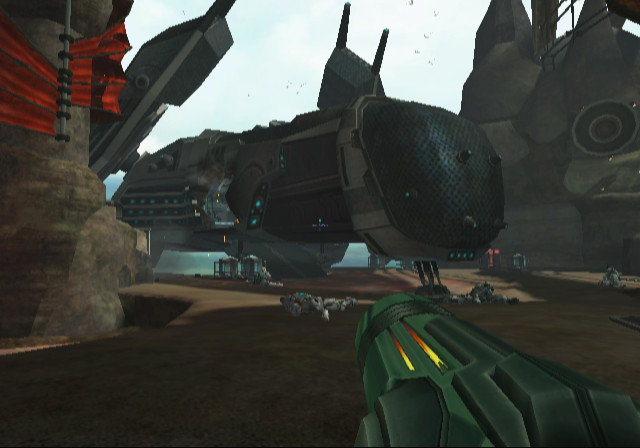
The compressed development schedule is apparent, not in the form of bugs or obvious rough edges, but in the diminished degree to which everything in the game seems to have been thought through. For instance, there are at least seven distinct factions present on Aether, with little rhyme or reason as to why they’re there beyond the initial plot setup. There is none of MP1’s gradual development of story through journal entries to be found here.
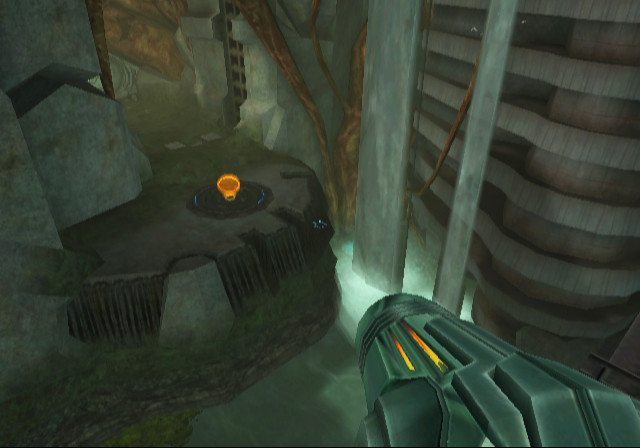
For those who managed to stick through the gruelling early sections, the final third of the game is much more rewarding. The player gets to thoroughly explore the Tron-like Forsaken Fortress and the mirror-world of Dark Aether, environments that are a bigger departure from Metroid Prime 1’s blueprint than what goes before. With most of Samus’s toys now available, the player is able to take in the lush scenery at a more leisurely pace. The light/dark ammunition system becomes less of a hinderance and a boatload of secret areas and morph ball mazes become accessible.
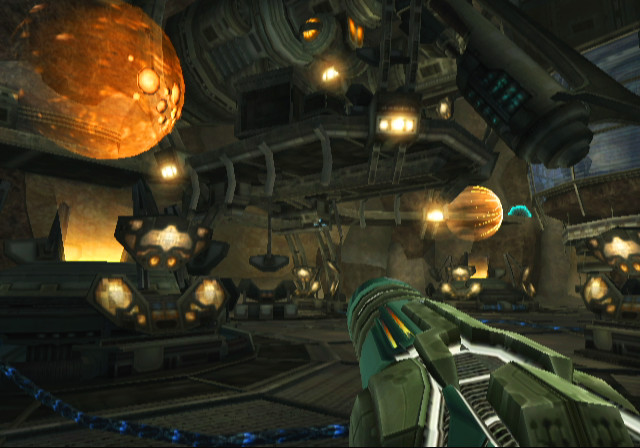
I remain unconvinced that Metroid Prime 2, even with it’s radical turnaround in the latter stages and richer (and longer) overall game experience, is a better game than the first. With a longer development time and more judicious editing and play balancing, the game could have been a clear improvement on the original in all aspects, but realistically I suppose the game had to be released before the GameCube’s life cycle began to wind down.
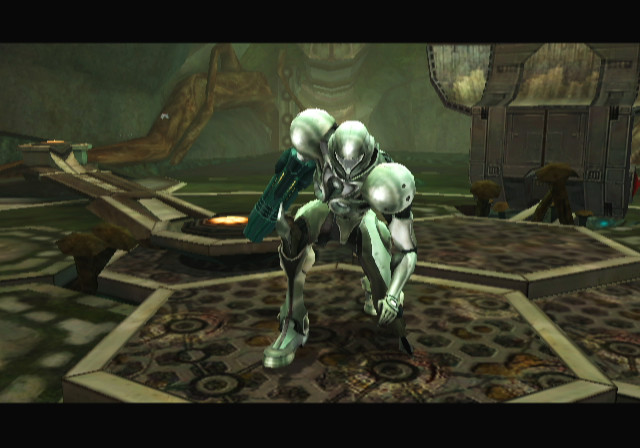
That aside, I am convinced that Metroid Prime 2 is an exceptionally beautiful and atmospheric game which deserves to be appreciated by more people. To that end, I’ve put together a gallery of screenshots showcasing many of the impressive sights that the planet Aether has to offer. Be warned that most of these were taken towards the end of the game, so if you’re paranoid about spoilers, look away now.
Tags: gallery, Game, game title, gamecube, metroid prime 2 echoes, nintendo, retro studios, screenshots
I really, really don’t want to make a habit of making posts just to comment on stories elsewhere, but I think this interview deserves a mention. Jeff Strain of Guild Wars developers Arena.Net draws attention to the barriers that Xbox Live’s business model puts in the way of MMO games for Microsoft’s consoles.
“They know it’s in their best interests to attract the top developers to develop for the console, and they know that that’s going to take some business model changes – and I think that what we’re going to see is that once the dust settles from the launch of this round of consoles, they’re going to be very willing to engage in those discussions. So yes, I think that there will be changes.”
I have argued for changes to Microsoft’s online strategy for years now, and it’s good to finally see a high profile developer speaking about this issue publically instead of avoiding the topic so as not to risk souring their relationship with Microsoft. With the Playstation 3 and Nintendo Revolution on the horizon (both expected to eschew Microsoft’s closed, subscription-based online model) and MMO games becoming increasingly mainstream and commercially important, it’s likely that the ‘battle of the business models’ will come to a head before the end of this year.
Update: Now Blizzard weigh in on the issue. The pressure is mounting.
Tags: commentary, guild wars, MMO, xbox live
This is a topic that you might expect to see investigated by Video Game Media Watch, although they’ve gone off the boil a bit recently so I thought I’d have a stab at it.
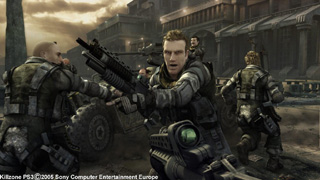
On May 16th, 2005, Sony Computer Entertainment demonstrated their forthcoming Playstation 3 console at the Electronic Entertainment Expo (E3). Part of the presentation was a showreel featuring several terrifically visually impressive demo sequences contributed by different development teams.
One of these sequences purported to represent a new game in the Killzone series, under development at Guerrilla Games (who have since been bought by Sony). (The first Killzone, you’ll remember, was a game that was positioned as a technical showcase for the Playstation 2, and which was released to lukewarm critical response in 2004.)
Almost immediately, rumours began to circulate that this demo (and others on the showreel) was not generated in realtime but was in fact prerendered. These rumours were denied by Sony and have to date never been verified by anybody at Sony or Guerrilla, and yet they persist. In fact, it seems that this piece of footage has provoked reactions from some people that have gone beyond rational scepticism and descended into bizarre, emotionally-charged (or perhaps agenda-driven) hostility. You can view the demo in question here.
Tags: commentary, killzone, killzonegate, naivety

